How the Which Heavenly Virtue Am I Dilemma Quiz Works
When people ask "which heavenly virtue am i," they usually want to know which moral instinct takes the wheel during messy, real-world friction. Our 10-dilemma matcher places you inside everyday conflicts (uncredited work, unpaid loans, and public criticism) where four respectable actions compete head to head.
Unlike standard agree-or-disagree questionnaires where you can rate yourself generously on every trait at once, forced-choice scenarios require trade-offs. When a manager mistakenly praises you for a teammate's late-night bug fix, do you redirect applause immediately (Humility), write a career-boosting endorsement afterward (Charity), document the system so nobody suffers again (Diligence), or create calm space for your colleague to speak (Patience)? None of those four instincts is bad, yet the one you reach for first exposes your natural center of gravity.
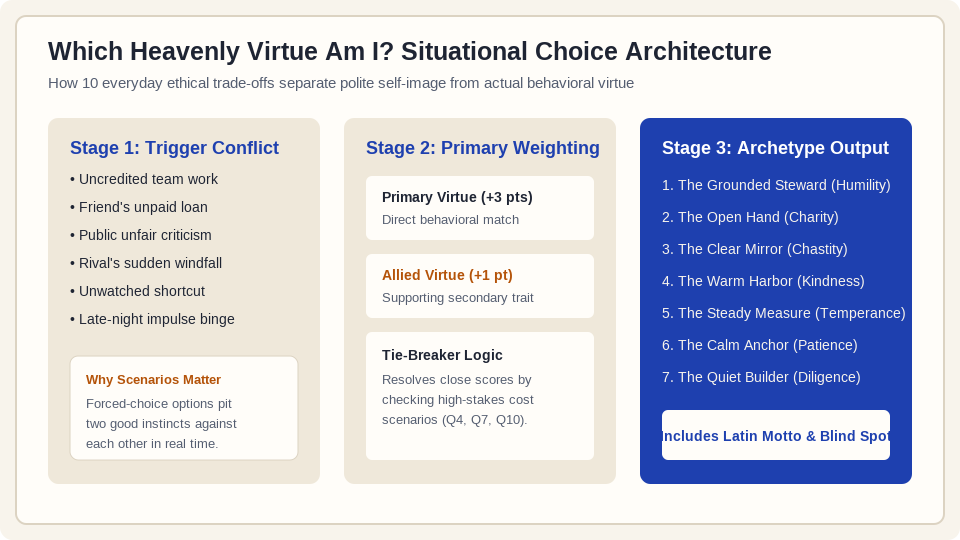
Each choice awards three points to its primary virtue and one point to a closely allied secondary virtue across a 40-point pool. If you also want an independent 0% to 100% radar score on every single trait, combine your archetype here with our full 28-question Heavenly Virtues Test on the homepage.
Why Situational Trade-Offs Reveal Character Faster
Asking yourself "which heavenly virtue am i" in the abstract often triggers wishful thinking, because almost everyone admires kindness, patience, and honesty in theory. Concrete scenarios bypass abstract self-flattery by forcing you to choose between saving time, protecting dignity, sharing money, or holding firm boundaries.
Moral psychologists have observed for decades that people judge themselves by their calmest intentions while others experience them through their hurried reactions. Ten well-chosen friction points cover the four arenas where character actually gets tested:
- Status and credit: Who gets named when a project succeeds, and how you absorb a rival winning an award you wanted.
- Money and margin: How you handle an unpaid $120 personal loan or an unexpected $600 cash windfall.
- Appetite and solitude: What you do at 11:45 PM before an early shift, or when you finish remote work three hours ahead of schedule with nobody checking.
- Social heat: How you respond to a flustered cashier, a harsh internet critic, or a group chat mocking an absent acquaintance.
Because no option reads like a cartoon villain, you cannot game the quiz simply by picking the "nice" line.
Overview of All Seven Virtue Archetypes
Answering "which heavenly virtue am i" through behavioral dilemmas maps your decisions to one of seven classical archetypes, each carrying a distinct strength, Latin motto, and overextension blind spot. Reviewing all seven archetypes side by side clarifies why friends handle identical emergencies in completely different ways.
- The Grounded Steward (Humility): Prioritizes truth over ego. Quick to share credit and study better methods without defensiveness, though prone to downplaying legitimate expertise.
- The Open Hand (Charity): Treats surplus time, cash, and social capital as tools to lift others immediately, needing firm boundaries only to avoid rescuer burnout.
- The Clear Mirror (Chastity): Keeps private conduct aligned with spoken commitments, resisting cheap validation or manipulative charm even when nobody would find out.
- The Warm Harbor (Kindness): Actively protects peers from humiliation and celebrates other people's breakthroughs with zero bitter comparison.
- The Steady Measure (Temperance): Exercises calm self-regulation over sleep, screens, food, and spending long before impulse turns into regret.
- The Calm Anchor (Patience): Absorbs provocation, clumsy delays, and heated misunderstandings without retaliating in anger.
- The Quiet Builder (Diligence): Delivers thorough, dependable craftsmanship after initial excitement wears off.
To inspect the deeper Latin etymology behind each trait, browse our complete guide to 7 Heavenly Virtues Meanings, or check how each archetype counters its opposite vice in 7 Heavenly Virtues vs 7 Deadly Sins.
Interpreting Close Ties in Your Archetype Score
If your top two traits finish within two points on this which heavenly virtue am i quiz, you operate with a blended moral style rather than a single dominant reflex. Look at whether your top pair clusters around interpersonal warmth, personal self-mastery, or steady practical duty.
For instance, a close finish between Kindness and Charity signals an outward, relationship-first orientation, whereas a tight pairing of Temperance and Diligence points to disciplined personal stewardship. Neither cluster outranks the other. Copy your ranked breakdown at the end of this which heavenly virtue am i assessment, compare notes with someone close to you, and notice where your instinctive blind spots complement theirs.
Which Heavenly Virtue Am I: Quiz FAQ
- Why did I get a different result here than on the 28-item scale?
- Self-report Likert scales measure your overall habit frequency across all seven virtues equally, while forced-choice dilemmas measure priority under trade-offs, specifically which virtue wins when you can only pick one action in the moment.
- Are there wrong or villainous choices in this 10-dilemma quiz?
- No. Every choice A through D represents a constructive, ethical action tied to a specific heavenly virtue (+3 primary points and +1 allied point). That design eliminates obvious socially desirable answers and reveals your genuine behavioral style.
- What are the seven archetypes in the Which Heavenly Virtue Am I matcher?
- Each classical virtue maps to a practical behavioral archetype: The Grounded Steward (Humility), The Open Hand (Charity), The Clear Mirror (Chastity), The Warm Harbor (Kindness), The Steady Measure (Temperance), The Calm Anchor (Patience), and The Quiet Builder (Diligence).
- How long does the 10-scenario quiz take to finish?
- Most readers finish all ten dilemmas in about two minutes. You can use the Previous Dilemma button at any step to reconsider an earlier choice before viewing your final ranking.
No reflections posted on this page yet. Take the test above and share your highest and lowest virtue percentages!