Decoding Score Tiers in Your Heavenly Virtues Test Results
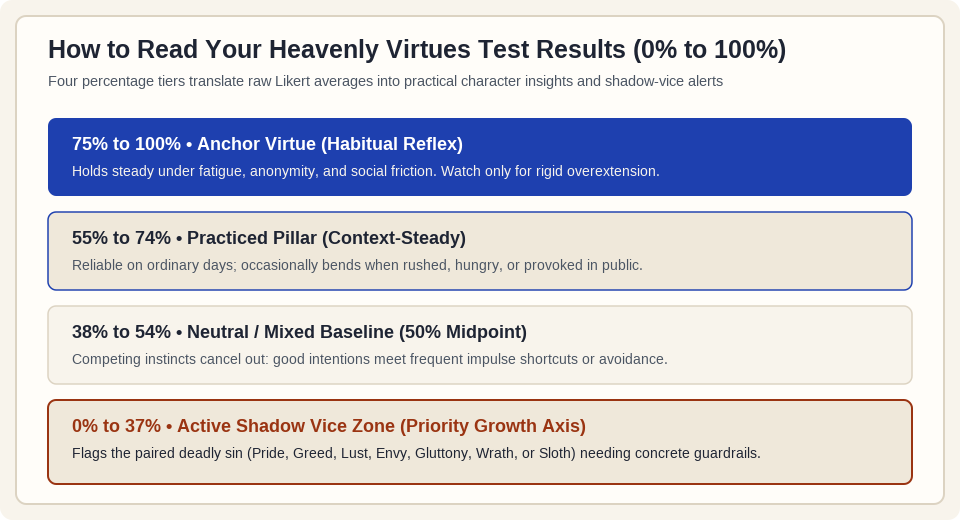
Your heavenly virtues test results report seven independent percentages from 0% to 100% rather than forcing you into one fixed personality bucket. Scores above 75% mark habitual strengths, 55% to 74% show steady situational habits, 38% to 54% reflect mixed trade-offs, and scores under 38% highlight shadow-vice friction.
Many first-time test takers assume percentages should sum to 100% like slices of a pie chart. Independent axis scaling works differently and far more realistically. Growing more generous in Charity never requires shrinking your Patience or Temperance. Each of the seven bars measures how consistently you choose a specific remedial habit over its paired capital temptation across four distinct prompts (in 6.25% steps on Full Scale, or 12.5% steps on Quick Mode).
If you arrived on this guide before running your own numbers, open the free 28-item Heavenly Virtues Test first so you have your seven percentages in front of you.
What Co-Dominant Ties and Blended Shapes Reveal
Seeing two or three traits finish within six percentage points in your heavenly virtues test results is common and informative. Rather than a scoring glitch, a narrow gap shows that your moral decisions rely on a paired habit cluster rather than a single isolated instinct.
Look at the functional relationship between your top two bars:
- Humility + Kindness: Signals a low-ego collaborator who shares credit readily and defuses status rivalry inside teams or friendships.
- Charity + Patience: Points to durable caregiving capacity, combining practical generosity with calm emotional endurance when people move slowly.
- Temperance + Diligence: Reflects strong private self-command over daily routines, sleep, spending, and long-term craftsmanship.
- Chastity + Humility: Highlights transparent personal integrity, where private behavior matches public commitments without showmanship.
When two virtues tie at the exact same percentage, test how they behave under forced scarcity by running our 10-scenario Which Heavenly Virtue Am I dilemma quiz, where you can only pick one action per conflict.
Why Your Lowest Score Matters Most for Habit Growth
The most practical line in your heavenly virtues test results is rarely your top badge; it is your lowest percentage bar, marked in ochre as your Shadow Vice Vulnerability. Classical ethics treats character like a wooden barrel whose capacity is governed by its shortest stave.
A person who scores 88% in Diligence and 82% in Temperance can still burn bridges in five angry seconds if Patience sits at 31% (leaving Wrath unguarded). Similarly, high Kindness paired with 35% Temperance often shows up as warm toward everyone else while binging late-night stress habits in private. Cross-check your lowest axis against our 7 Heavenly Virtues vs 7 Deadly Sins table and review the balanced middle path in 7 Heavenly Virtues Meanings.
Accuracy, Retakes, and Limitations of Self-Report Quizzes
How reliable are online heavenly virtues test results? In personality psychology, balanced Likert assessments provide solid self-reflection consistency when answered candidly, yet they remain educational mirrors rather than clinical psychological instruments. Mood, recent arguments, and sleep debt can nudge individual bars by 6% to 12% on any given day.
Three simple practices keep your heavenly virtues test results grounded in reality:
- Answer by last month's actions, not lifelong ideals: Ask what you actually did the last two times a cashier was slow or a peer succeeded, not what you believe is noble.
- Avoid rushing neutral clicks: Overusing option 3 compresses your astrolabe polygon toward the 50% ring and hides real distinctions.
- Compare with someone who knows you well: Use the friend comparison link on the homepage to overlay your self-view with a trusted partner or friend.
Retaking the quiz every few months is completely free and unlimited. Tracking your heavenly virtues test results across calm weeks and busy seasons shows which virtues are truly anchored and which ones still need deliberate guardrails.
Heavenly Virtues Test Results: FAQ
- How accurate are online heavenly virtues test results?
- Self-report moral scales capture honest behavioral tendencies rather than clinical diagnoses. Because half of our 28 prompts are reverse-keyed temptation checks, scores resist polite agreement inflation, though accuracy still depends on answering how you actually behave rather than how you wish to behave.
- Why can all seven percentages add up to more than 100%?
- Each virtue is scored on its own independent 0% to 100% scale rather than sliced from a single pie. Scoring 80% on Kindness does not force Patience or Diligence down; a person can score high or low across multiple axes simultaneously.
- What does a flat 50% score across several virtues indicate?
- Fifty percent is the exact mathematical midpoint produced when forward habits and reverse temptation prompts balance each other out (or when Neutral is selected repeatedly). It signals a situational habit that holds on easy days and slips under stress.
- Can I retake the assessment unlimited times to compare changes?
- Yes. There are no retake limits, cooldowns, or account locks. Save your PNG score card today and retake the 28-item scale after thirty days of habit practice to see how your polygon shifts.
Measure Your Own Seven-Virtue Spectrum
Score Humility, Charity, Chastity, Kindness, Temperance, Patience, and Diligence in under 4 minutes—free and private.
No reflections posted on this page yet. Take the test above and share your highest and lowest virtue percentages!