What Does the Heavenly Virtues Test Measure?
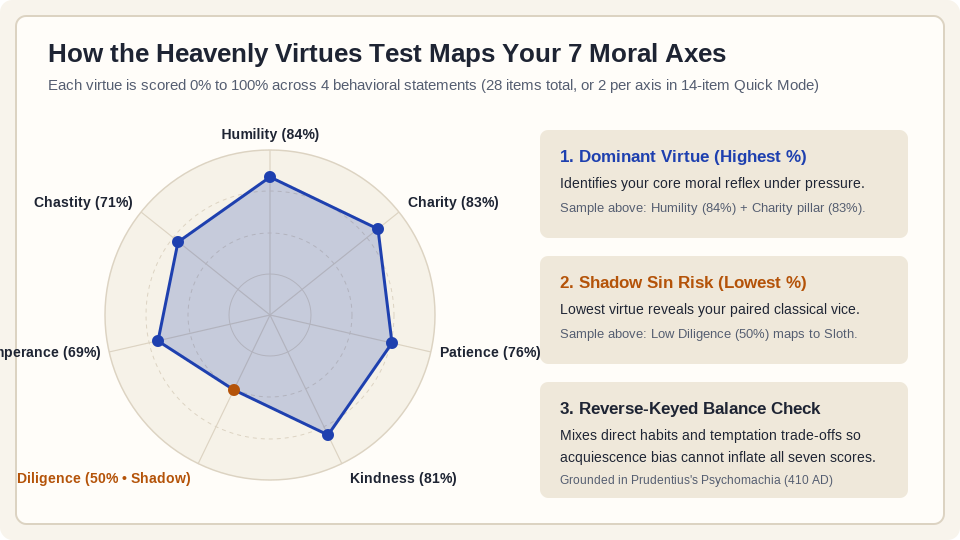
The heavenly virtues test measures seven distinct moral habits: Humility, Charity, Chastity, Kindness, Temperance, Patience, and Diligence. Rather than forcing you into a single rigid personality box, this 28-question assessment scores each trait on an independent 0% to 100% scale and maps your complete ethical profile.
Most casual internet quizzes hand out a flattering one-word label after six obvious questions. Real character rarely works that way. A person can show extraordinary Diligence at work while running dangerously low on Patience in traffic, or practice generous Charity toward strangers while struggling with private Temperance late at night. Measuring all seven axes on this heavenly virtues test independently shows where your self-command holds steady and where friction wears it thin.
If you prefer concrete workplace and relationship conflicts over five-point agreement scales, you can also try our companion Which Heavenly Virtue Am I scenario matcher, which pits two good instincts against each other across ten everyday dilemmas.
How Scoring Works Across All Seven Axes
Each axis in our heavenly virtues test combines two direct habit statements with two reverse-keyed temptation prompts on a five-point Likert scale. Reverse scoring prevents polite agreement bias, ensuring that clicking "Strongly Agree" down the page produces a flat 50% baseline rather than an inflated 100% score.
Psychometricians call the urge to nod along with respectable statements acquiescence bias. When a moral quiz only asks whether you value honesty or generosity, almost everyone clicks agree and walks away with a muddled tie. Mixing direct habits with candid friction prompts (such as how you react when a rival stumbles or when an unmonitored shortcut appears) forces real separation on the heavenly virtues test between your strongest and weakest habits.
| Heavenly Virtue | Latin Term | Paired Capital Sin | Core Behavioral Signal Measured |
|---|---|---|---|
| Humility | Humilitas | Pride (Superbia) | Sharing credit, welcoming correction, judging ideas over status |
| Charity | Caritas | Greed (Avaritia) | Uncalculated generosity with money, time, and leverage |
| Chastity | Castitas | Lust (Luxuria) | Wholehearted fidelity, clear boundaries, non-exploitative desire |
| Kindness | Humanitas | Envy (Invidia) | Genuine joy at another person's win, refusal to pile onto gossip |
| Temperance | Temperantia | Gluttony (Gula) | Knowing where enough lives across food, screens, and spending |
| Patience | Patientia | Wrath (Ira) | Composed restraint under provocation, delay, or unfairness |
| Diligence | Industria | Sloth (Acedia) | Quiet follow-through on unglamorous duties after novelty fades |
Every prompt converts your 1-to-5 response into a linear 0-to-100 contribution for its assigned axis (with reverse items inverted as 6 - response first). On the full heavenly virtues test, scoring averages four prompts per virtue in 6.25% increments, while Quick Mode averages two high-discrimination prompts per virtue in 12.5% increments.
Reading Your Dominant Virtue and Shadow Deadly Sin
Your highest percentage on the heavenly virtues test identifies your dominant moral reflex, while your second-highest score reveals your supporting pillar. Equally informative is your lowest percentage, which pinpoints your paired shadow deadly sin: the specific classical vice most likely to surface under fatigue or pressure.
Across all seven bars, scores from 75% to 100% suggest an anchor virtue that stays relatively consistent in everyday conduct; 55% to 74% reflects a practiced pillar that holds on ordinary days but bends under rush or stress; 38% to 54% marks a mixed baseline around the 50% midpoint; and 0% to 37% highlights an active shadow-vice zone worth deliberate guardrails (see our full Heavenly Virtues Test Results guide for score bands and self-report limitations).
For a full historical breakdown of how each remedial habit counters its opposite vice, read our side-by-side 7 Heavenly Virtues vs 7 Deadly Sins reference chart. You can also inspect the subtle difference between healthy virtue and rigid overcorrection (such as when Humility curdles into self-erasure, or Charity turns into martyr burnout) in our guide to 7 Heavenly Virtues Meanings.
Historical Roots: From Prudentius to Modern Character Scales
The seven traits used in every modern heavenly virtues test trace back to Aurelius Prudentius Clemens, a Roman Christian poet who published the allegorical poem Psychomachia (Battle of the Soul) around 410 AD. His verse paired seven remedial virtues directly against seven capital vices in single combat.
Before Prudentius, fourth-century monastic writers like Evagrius Ponticus had cataloged eight destructive "evil thoughts" (logismoi) that derailed contemplative discipline, later condensed into seven capital sins by Pope Gregory I in 590 AD. Prudentius gave ordinary readers a memorable counter-framework that still anchors every serious heavenly virtues test today:
- Humilitas (Humility) Restrains Superbia (boastful Pride).
- Caritas (Charity) Unclenches Avaritia (hoarding Greed).
- Castitas (Chastity) Grounds Luxuria (consuming Lust).
- Humanitas (Kindness) Dissolves Invidia (corrosive Envy).
- Temperantia (Temperance) Balances Gula (runaway Gluttony).
- Patientia (Patience) Outlasts Ira (vindictive Wrath).
- Industria (Diligence) Wakens Acedia (apathetic Sloth).
Over the centuries, painters, dramatists, and moral philosophers kept this sevenfold symmetry alive because it describes everyday human psychology with surprising precision, whether you read it through a religious lens or purely as secular character ethics.
Practical Ways to Use Your Heavenly Virtues Test Results
Treat your heavenly virtues test report as a baseline snapshot rather than a permanent verdict on your character. Focus your energy for one week on the single virtue where you scored lowest, using concrete friction rules rather than vague willpower, then retake the heavenly virtues test next month.
Comparing radar polygons with a partner, close friend, or coworker often reveals why two well-meaning people clash. Use the Compare With a Friend button on your results screen to generate a private comparison link: someone high in Diligence (88%) and lower in Patience (52%) may push hard on deadlines, whereas a friend high in Patience (86%) and Kindness (84%) prioritizes team morale first. Seeing both seven-point shapes overlaid on one astrolabe turns friction into mutual respect. Whenever life routines shift, come back to this heavenly virtues test to check how your daily habits have recalibrated.
Sample prompts inside the widget include forward habits such as "When a group project goes well, I actively point out specific teammates whose quiet work made the difference" (Humility) alongside reverse-keyed checks like "Hearing that a peer in my field landed a major breakthrough secretly ruins my mood for the rest of the afternoon" (Kindness vs. Envy).
Heavenly Virtues Test: Common Questions
- Is this heavenly virtues test free and private?
- Yes. Scoring runs locally inside your web browser with zero registration, email gate, or paywall. Individual item selections stay in your browser; our server only receives anonymous aggregate tallies, or a nickname and seven percentages if you voluntarily create a friend comparison link or post a public comment.
- How many questions are in the full heavenly virtues test?
- The standard scale includes 28 statements (four items for each of the seven virtues, split evenly between positive habits and reverse-keyed temptation checks). If you want a faster snapshot, click Quick Mode at the top of the quiz to run a 14-question version in under two minutes.
- Why does the quiz show a shadow deadly sin alongside my top virtue?
- In fourth-century moral philosophy, each heavenly virtue was formulated specifically as the behavioral counterweight to one of the seven deadly sins. Your lowest-scoring virtue points to the paired capital vice most likely to trip you up when you are tired, stressed, or unguarded.
- Can two virtues tie for first place on my heavenly virtues test radar chart?
- Yes. Because each axis in this heavenly virtues test is normalized independently from 0% to 100%, two traits can land on the exact same percentage. When a tie occurs, read both your primary badge and your Secondary Moral Pillar card together, since co-dominant traits usually operate as a pair in daily life.
- How is this heavenly virtues test different from Faith, Hope, and Charity?
- The seven traits in this heavenly virtues test (Humility, Charity, Chastity, Kindness, Temperance, Patience, and Diligence) are the practical anti-vice list popularized after Prudentius wrote the Psychomachia around 410 AD. By contrast, medieval scholasticism also grouped three theological virtues (Faith, Hope, Charity) with four Greek cardinal virtues (Prudence, Justice, Temperance, Fortitude).
- Does the quiz work on iPhone, Android, and tablets without downloading an app?
- Yes. The entire assessment and 7-axis radar chart run directly in mobile Safari, Chrome, Firefox, and tablet browsers with touch-friendly buttons, requiring zero downloads or file uploads.
- Can I retake the assessment unlimited times, and is it accurate?
- You can retake both the 28-item Full Scale and 14-item Quick Mode unlimited times for free. Balanced forward and reverse-keyed prompts reduce agreement bias for personal self-reflection, though results are educational rather than a clinical diagnosis.
- What is the difference between the 14-question Quick Mode and 28-question Full Scale?
- Quick Mode offers a fast two-minute snapshot using two items per virtue (one direct habit and one reverse-scored check). Full Scale uses four items per virtue (28 total) for finer 6.25% score steps across the same seven classical virtues.
No reflections posted on this page yet. Take the test above and share your highest and lowest virtue percentages!